




Vikram Gulati Urges R&D Focus, Warns of Geopolitical Supply Chain Risks
Gulati outlined a multi-pronged approach to address these challenges: fostering collaboration between industry and academia, investing in core R&D capabilities, strategically purchasing certain technologies in the short term
 11 Nov 2025
 1365 Views
Share -
1365 Views
Share -


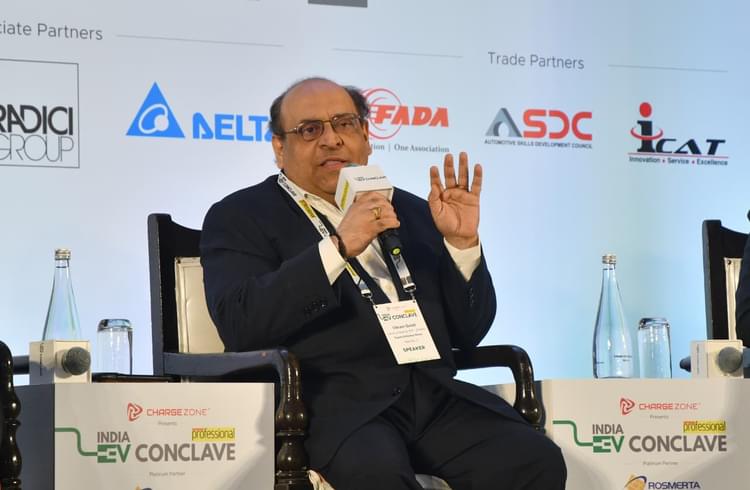
Vikram Gulati, Country Head and Executive Vice President (Corporate Affairs & Governance) at Toyota Kirloskar Motor, expressed concern about insufficient emphasis on research and development in India's electric vehicle sector, warning that the country risks vulnerability to geopolitical supply chain disruptions.
Speaking at the India EV Conclave panel discussion, Gulati acknowledged the government's efforts through FAME schemes, tax incentives, and GST reforms but lamented the declining priority given to R&D. "When we started out, R&D was given primary focus. Sad about R&D," Gulati said, emphasizing that while demand-side interventions like subsidies can jumpstart market segments, sustainable growth requires supply-side interventions, charging infrastructure, and robust R&D.
The government has launched several initiatives to promote EV adoption, including the FAME scheme introduced in 2015, with FAME II starting in April 2019 and focusing on electrifying public and shared transportation. However, Gulati argued that these demand-focused measures, while necessary, are insufficient without parallel investments in domestic innovation and manufacturing capabilities.
"In future there could be the possibility of denial of parts, raw material due to geopolitical issues," Gulati warned, highlighting the automotive industry's exposure to international supply chain vulnerabilities. He stressed that building resilience requires "collaboration and core R&D, which can't be done by the government alone."
Gulati outlined a multi-pronged approach to address these challenges: fostering collaboration between industry and academia, investing in core R&D capabilities, strategically purchasing certain technologies in the short term where domestic development isn't feasible, and achieving scale in manufacturing to drive down costs.
On the question of technology pathways, Gulati made a case for hybrid vehicles as a transitional solution. "Hybrids have common EV parts that can allow faster consumer adoption," he said, suggesting that hybrids could help accelerate the development of the broader EV ecosystem while providing consumers with range-security and lower initial costs.
Gulati also challenged what he sees as excessive pessimism about India's EV progress. "Reaching 5% EV adoption in a country like India should be celebrated rather than looked down upon," he said, noting the unique challenges of India's diverse market, infrastructure constraints, and consumer price sensitivity.
The Toyota executive also highlighted an often-overlooked aspect of the EV transition: the industry's contribution to the national exchequer. "15% of GST collection comes from auto. There are too many sectors which are more deserving of incentives than automotive," Gulati said, suggesting that policymakers should recognize the auto sector's fiscal importance when designing support schemes.
On the critical issue of workforce development, Gulati made a bold proposal: "All OEMs need to put 50% of CSR towards skilling." He warned that resistance to EV adoption will persist unless aftermarket technicians receive proper training, and noted positively that green energy vehicles are attracting more women to technical training programs.
In 2024, India's electric vehicle sales crossed 2 million units, marking 24% growth and representing approximately 8% market share, up from 6.8% in 2023. While this represents significant progress, Gulati emphasized that maintaining and accelerating this momentum will require moving beyond incentives to building genuine domestic capabilities.
"We need collaboration, core R&D which can't be done by government alone, buying some technology, and focus on scale," Gulati summarized, outlining what he sees as the roadmap for India's EV industry to move from subsidy-dependent growth to sustainable, innovation-driven expansion.
Gulati's concerns about supply chain vulnerability and R&D investment reflect broader anxieties in the Indian automotive industry about the sector's long-term competitiveness. With China dominating global EV supply chains and Western markets increasingly implementing protectionist measures, India faces pressure to rapidly build domestic capabilities while avoiding the pitfalls of either excessive import dependence or isolated, uncompetitive local production.
The India EV Conclave 2025 was presented by Chargezone, with Rosmerta Technologies as the Platinum Partner. The event is powered by IPG Automotive and Gulf Oil Lubricants India, with PTC serving as the Technology Partner. Associate Partners include Spark Minda, Radici Group, and Delta Electronics. The conclave also has trade partnerships with FADA, ASDC, and ICAT.
RELATED ARTICLES
Citroën India Reports Three-Fold Sales Increase in Q4 2025
 Shruti Shiraguppi
16 Dec 2025
Shruti Shiraguppi
16 Dec 2025
Automaker's new strategy drives growth as Q4 sales reach three times Q3 levels, with vehicle exports up 18.8 percent.

Tata Group Reviews Clean Energy and EV Manufacturing Plans in Uttar Pradesh
 Angitha Suresh
16 Dec 2025
Angitha Suresh
16 Dec 2025
Tata Group leadership discussed progress on power generation, renewable energy projects, and potential expansion of vehi...
Hyundai NEXO Receives Top Safety Rating from Euro NCAP
Angitha Suresh
16 Dec 2025
The hydrogen fuel-cell SUV earned five stars in European safety testing, scoring 90 percent for adult occupant protectio...