


India Turns to Multimodal Strategy for Green Mobility Transition: S&P Global
India is pursuing a multimodal and multifuel approach to green mobility, combining electric vehicles, biofuels, hybrids, and hydrogen as part of its transport decarbonization strategy, according to a new report by S&P Global.
 By Arunima Pal
 2103 Views


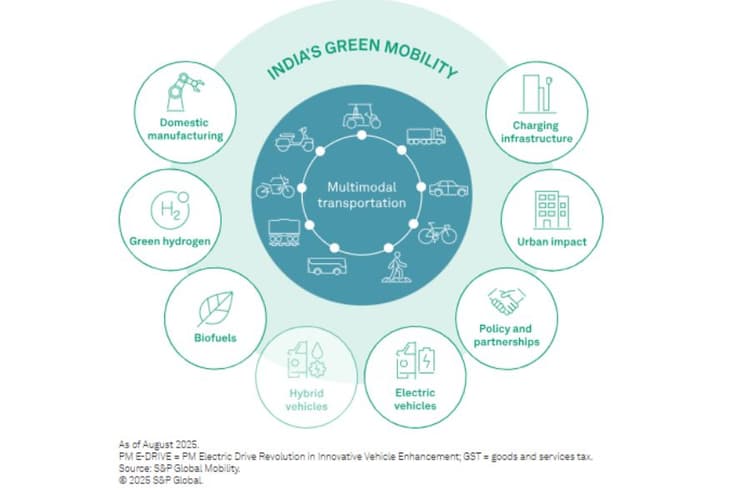
India is accelerating efforts to reform its transportation sector as it confronts growing urban mobility challenges, pollution, and high logistics costs. According to a report by S&P Global, the country is embracing a multimodal and multifuel approach in its push toward sustainable transport.
The report highlights that while electric vehicles (EVs) are expanding rapidly — especially among two-wheelers, three-wheelers, and commercial vehicles — other technologies such as biofuels, hybrids, and green hydrogen are essential for existing fleets and heavy-duty transport. Government policy is seen as a key enabler: EV subsidies, incentives for domestic manufacturing, infrastructure expansion, and regulatory support are all part of this strategy.
As of 2024, the EV sector in India registered nearly 1.9 million units sold, translating into about 7.5% market penetration. Still, high upfront costs, limited charging infrastructure, and concerns over vehicle range remain obstacles. To address these, the government has launched schemes to boost charging networks, set ambitious production and investment targets, and introduced measures for battery recycling and reducing reliance on imports.
States are also playing a role: Delhi, Kerala, Assam, Karnataka, and Uttar Pradesh are among those leading in EV adoption, thanks in part to aggressive incentives, favorable policy environments, and infrastructure roll-outs.
Beyond EVs, biofuels and hydrogen are being positioned for roles in decarbonizing India’s transport system. The aim is to reach 20% ethanol blending in gasoline by 2025-26 and 5% biodiesel by 2030, while planning for green hydrogen use in heavy vehicles and fleet vehicles.
S&P Global’s report identifies several priorities for further action: ensuring stable long-term policy frameworks, scaling infrastructure — especially public charging — in underserved areas, building local battery and component supply chains, enforcing standards in recycling and circular economy practices, and focusing on skills development for the evolving green mobility ecosystem.
RELATED ARTICLES

Citroën India Reports Three-Fold Sales Increase in Q4 2025
 Shruti Shiraguppi
 16 Dec 2025
Automaker's new strategy drives growth as Q4 sales reach three times Q3 levels, with vehicle exports up 18.8 percent.


Tata Group Reviews Clean Energy and EV Manufacturing Plans in Uttar Pradesh
 Angitha Suresh
16 Dec 2025
Angitha Suresh
16 Dec 2025
Tata Group leadership discussed progress on power generation, renewable energy projects, and potential expansion of vehi...

Hyundai NEXO Receives Top Safety Rating from Euro NCAP
Angitha Suresh
16 Dec 2025
The hydrogen fuel-cell SUV earned five stars in European safety testing, scoring 90 percent for adult occupant protectio...