




India EV Industry Leaders Call for Enhanced Charging Infrastructure, Used EV Market Development
Executives from Tata Motors, Mahindra & Mahindra, JSW MG Motor India, BMW, and Mercedes-Benz outlined both opportunities and challenges facing India's rapidly evolving EV sector.
 11 Nov 2025
 2775 Views
Share -
2775 Views
Share -


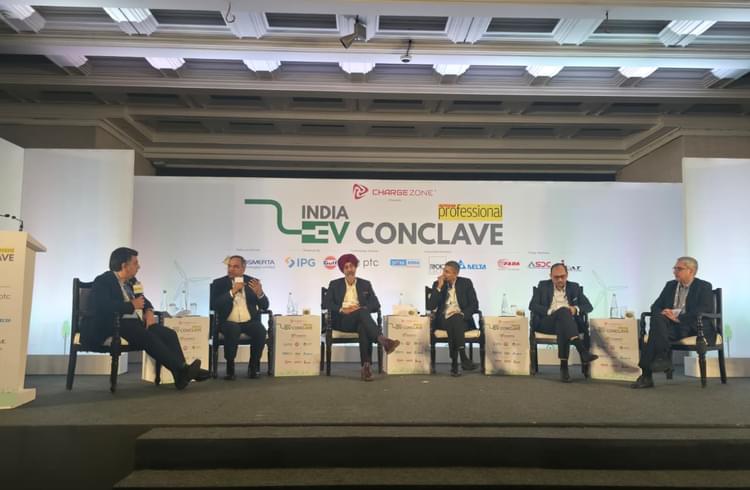
Industry leaders at Autocar Professional's India EV Conclave 2025 emphasized the urgent need for stronger charging infrastructure and a more robust used EV market to sustain India's electric vehicle growth momentum, with forecasts of EV penetration reaching 25-30% by 2030.
Speaking at the event at Hyatt Regency Delhi, executives from Tata Motors, Mahindra & Mahindra, JSW MG Motor India, BMW, and Mercedes-Benz outlined both opportunities and challenges facing India's rapidly evolving EV sector, which currently accounts for approximately 7.5% of total vehicle sales.
India's EV market reached approximately 1.94 million units in 2024, marking a 26.5% year-on-year increase, with overall EV penetration rising to 7.46% from 6.39% in 2023. The sector has witnessed particularly strong growth in the electric two-wheeler and three-wheeler segments, while the passenger vehicle segment is gradually gaining traction.
BMW Group India's President & CEO Hardeep Brar highlighted a significant infrastructure deficit, noting that India's charging infrastructure ratio stands at approximately 1:40 (one charger for every 40 vehicles), substantially lower than developed countries where the ratio is around 1:20. This infrastructure gap, according to industry executives, represents one of the most pressing challenges to accelerating EV adoption beyond tier-1 cities.
The charging infrastructure discussion gained particular prominence as JSW MG Motor India's MD Anurag Mehrotra revealed that EV adoption is "going far beyond a tier-1 phenomenon," indicating that demand is spreading to smaller cities despite infrastructure constraints.
Tata Motors' MD and CEO Shailesh Chandra called for urgent attention to the used EV market, particularly in the sub-Rs 10 lakh segment. "In India, resale value is a sensitive issue. The demand has not been created on the used EV side. Used car players need to create the market," Chandra stated, adding that Tata Motors is creating a used car market with 50-100 vehicles to demonstrate viability.
The absence of a mature secondary market for electric vehicles has been identified as a potential barrier to first-time EV buyers, who often express concerns about battery health and resale values.
Industry leaders expressed confidence in achieving significant EV penetration by 2030, with most forecasting figures well above the government's 30% target. Tata Motors projects more than 30% EV penetration in its portfolio, while JSW MG Motor India expects new energy vehicles (including hybrids and EVs) to comprise 25-30% of the market.
Mahindra's CEO of the Automotive Division, Nalinikanth Gollagunta, emphasized that "e-SUVs will be the clear winner in the EV space," pointing to a three-fold increase in electric SUV sales. He added that margin issues in EVs will be resolved through higher localization and declining cell prices.
Chandra noted that government support has been instrumental in bridging the price gap between internal combustion engine vehicles and EVs, but emphasized that subsidy dependence can decrease once the market achieves 15-20% EV penetration. He observed that while EVs experienced exponential growth from 2020-2024, a temporary slowdown occurred due to confusion between EVs and hybrids, though sales have recently picked up with fast-charging and longer-range options.
The next stage of growth, according to Chandra, will come from cost reduction in entry-segment EVs, making electric mobility accessible to a broader consumer base.
The luxury vehicle segment has emerged as a surprising leader in EV adoption rates. BMW's iX1 has achieved 60% EV penetration, with the company reporting 250% growth in EV sales. Brar attributed this to economies of scale, technology appeal, and lower cost of ownership, noting that "between petrol and BEVs, people are choosing BEVs."
Mercedes-Benz India's MD & CEO Santosh Iyer emphasized that taxation has a bigger impact on the luxury EV segment, stating that "the moment on-road prices of EVs are below ICE, the sales fly." He revealed that the company achieved 45% diesel sales post-GST 2.0 because total cost of ownership favored diesel, suggesting similar dynamics could accelerate luxury EV adoption.
Both luxury automakers highlighted the importance of assured residual value programs in driving sales, with Brar noting this helps the luxury segment overcome buyer hesitation about long-term EV ownership.
Gollagunta of Mahindra pointed to Advanced Cell Chemistry (ACC) localization as a critical missing piece in India's EV ecosystem. "One critical aspect is ACC localization has not played out well. It'll be a huge gamechanger for us if this happens," he stated, indicating that domestic battery production could significantly reduce costs and improve supply chain resilience.
The industry consensus at the conclave points to a maturing EV ecosystem that requires coordinated efforts across infrastructure development, market creation, and supply chain strengthening to sustain its impressive growth trajectory toward 2030 targets.
The India EV Conclave 2025 was presented by Chargezone, with Rosmerta Technologies as the Platinum Partner. The event is powered by IPG Automotive and Gulf Oil Lubricants India, with PTC serving as the Technology Partner. Associate Partners include Spark Minda, Radici Group, and Delta Electronics. The conclave also has trade partnerships with FADA, ASDC, and ICAT.
RELATED ARTICLES
Citroën India Reports Three-Fold Sales Increase in Q4 2025
 Shruti Shiraguppi
16 Dec 2025
Shruti Shiraguppi
16 Dec 2025
Automaker's new strategy drives growth as Q4 sales reach three times Q3 levels, with vehicle exports up 18.8 percent.

Tata Group Reviews Clean Energy and EV Manufacturing Plans in Uttar Pradesh
 Angitha Suresh
16 Dec 2025
Angitha Suresh
16 Dec 2025
Tata Group leadership discussed progress on power generation, renewable energy projects, and potential expansion of vehi...
Hyundai NEXO Receives Top Safety Rating from Euro NCAP
Angitha Suresh
16 Dec 2025
The hydrogen fuel-cell SUV earned five stars in European safety testing, scoring 90 percent for adult occupant protectio...