


Hyundai India Embraces Software-Defined Manufacturing with AI and Robotics
Automaker introduces Boston Dynamics SPOT robots for quality inspection, AI-powered testing systems, and real-time monitoring platforms as part of shift toward software-defined production facilities.
 2177 Views


Hyundai Motor India is transforming its manufacturing operations into intelligent, AI-driven production facilities, deploying robot-assisted quality inspection, end-of-line AI testing, and digital command centers that leverage big data analytics for real-time factory monitoring and optimization.
At the company's investor day presentation today, Hyundai outlined its vision for a "Software Defined Factory" built on three pillars: Auto Flex (advanced, flexible automation), Humanity (human-friendly smart technology), and Intelligent Control (artificial intelligence and big data). This represents a fundamental shift from mechanized production to intelligent, adaptive systems that can learn, optimize, and respond dynamically to changing conditions.
Auto Flex: Advanced, Flexible, Automation
The Auto Flex pillar addresses manufacturing's persistent challenge of producing multiple vehicle variants on the same production line with minimal changeover downtime. Traditional assembly lines are optimized for single-model, high-volume production, making it costly and time-consuming to switch between vehicles.
Hyundai's flexible automation uses programmable robotics, modular tooling, and software-controlled processes that can be reconfigured rapidly through digital commands rather than physical retooling. This enables the Chennai plant to build everything from compact hatchbacks to large SUVs, ICE vehicles to EVs, on shared infrastructure—dramatically improving asset utilization.
This flexibility is crucial given Hyundai's ambitious roadmap: eight hybrid models by FY30, multiple new EVs, Genesis luxury brand launch in 2027, and continued ICE vehicle refreshes. A software-defined factory accommodates this product complexity without proportional increases in manufacturing footprint or capital expenditure.
AI Inspection: Human + SPOT Robot Quality Control
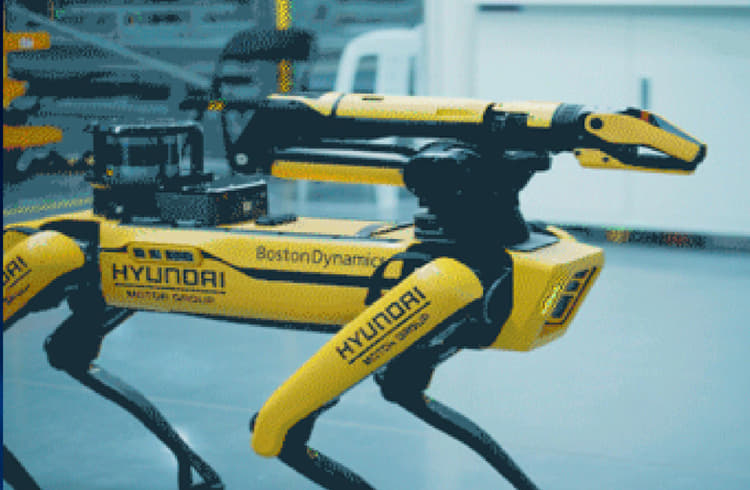
Perhaps most striking is Hyundai's deployment of AI-powered inspection featuring Boston Dynamics' SPOT quadruped robot, which navigates factory environments autonomously while conducting quality inspections.
The "Human + SPOT in Quality Inspection" approach emphasizes collaboration where AI augments rather than replaces human expertise. SPOT robots, equipped with high-resolution cameras, thermal sensors, and inspection tools, patrol production areas examining vehicle bodies, welds, paint quality, and assembly accuracy.
The robots access hard-to-reach areas—crawling under vehicles, inspecting overhead structures, or examining confined spaces—that would be difficult or dangerous for human inspectors. AI algorithms analyze captured images in real-time, comparing them against digital specifications to identify defects with micron-level precision.
Critically, human inspectors remain central, providing contextual judgment, assessing subjective quality attributes, and making decisions about whether variations warrant rework. This hybrid model combines AI's consistency and speed with human expertise.
Robot-assisted inspection also generates valuable data, creating digital records that identify recurring issues, correlate defects with specific shifts or suppliers, and enable continuous quality improvement through root cause analysis.
AI in Tester Line: Efficient End-of-Line Confirmation
Complementing robot inspectors is an AI system in the tester line for "Efficient End of Line Confirmation"—the final validation before vehicles leave the factory.
Hyundai's AI system automates much of this validation, using sensors, cameras, and connected diagnostics to rapidly assess vehicle functionality. It simultaneously tests multiple parameters—electrical systems, torque specifications, fluid levels, brake performance, sensor calibrations, and software systems.
The AI approach is faster (completing in minutes tests requiring 30-45 minutes manually), consistent (identical protocols regardless of shift or operator), comprehensive (checking hundreds of parameters impractical for manual verification), and generates complete documentation—a digital quality passport for every vehicle.
For complex vehicles—particularly EVs and hybrids with sophisticated battery management, advanced driver assistance, and connected technologies—AI-driven testing becomes essential as testable parameters exceed what human inspectors can feasibly validate.
Digital Command Center: H-Meta Studio Monitoring
Orchestrating the entire operation is a "Digital Command Center" using "H-Meta Studio for Monitoring"—essentially a manufacturing metaverse providing real-time visibility into every production aspect.
The sophisticated control room features multiple displays showing factory layouts, production metrics, equipment status, and analytics dashboards. Operators monitor production flow, identify bottlenecks, track quality metrics, oversee equipment performance, manage energy consumption, and coordinate logistics from a centralized location.
H-Meta Studio suggests immersive 3D visualizations of factory operations, possibly including VR or AR interfaces allowing managers to "walk through" the digital factory or simulate process changes before physical implementation.
Big data analytics and AI power this command center. Factory sensors generate continuous data streams—robot cycle times, conveyor speeds, inspection results, material flow, equipment temperatures, energy consumption. AI algorithms analyze these streams to identify patterns, predict equipment failures, optimize production schedules, and recommend improvements.
Predictive maintenance alone delivers substantial value. By analyzing vibration patterns, temperature profiles, and operational data, AI identifies early failure warnings—allowing proactive intervention during scheduled downtime rather than unexpected production-halting breakdowns.
Humanity: Human-Friendly Smart Technology
Hyundai emphasizes "Humanity" as a core pillar—"human-friendly smart technology" that enhances rather than dehumanizes work, creating safer, more ergonomic, and more fulfilling roles.
Collaborative robots handle repetitive or physically demanding tasks while humans focus on skilled work requiring judgment. Exoskeletons reduce physical strain. Digital instructions and AR guidance help workers perform complex assembly with greater accuracy. AI-driven scheduling optimizes shift patterns balancing productivity with well-being.
This human-centric automation is particularly relevant in India's labor context, where manufacturing provides crucial employment while automation improves competitiveness. Hyundai's approach creates higher-value jobs in robot programming, AI system management, and advanced manufacturing operations.
Strategic Implications
The software-defined factory positions Hyundai to compete on agility, quality consistency, and the ability to produce increasingly complex vehicles efficiently. As the industry undergoes profound transformation with electrification, autonomous capabilities, and software-defined vehicles, manufacturing must evolve correspondingly.
Hyundai's Chennai facility—with 824,000 units annual capacity—serves as a testbed for these technologies before potential global deployment. As Hyundai prepares to manufacture Genesis vehicles, produce multiple EV models, locally manufacture battery cells, and scale hybrid production while maintaining high conventional vehicle volumes, the software-defined factory becomes the enabling infrastructure that makes this unprecedented product complexity manageable.
RELATED ARTICLES

Citroën India Reports Three-Fold Sales Increase in Q4 2025
 Shruti Shiraguppi
 16 Dec 2025
Automaker's new strategy drives growth as Q4 sales reach three times Q3 levels, with vehicle exports up 18.8 percent.


Tata Group Reviews Clean Energy and EV Manufacturing Plans in Uttar Pradesh
 Angitha Suresh
16 Dec 2025
Angitha Suresh
16 Dec 2025
Tata Group leadership discussed progress on power generation, renewable energy projects, and potential expansion of vehi...

Hyundai NEXO Receives Top Safety Rating from Euro NCAP
Angitha Suresh
16 Dec 2025
The hydrogen fuel-cell SUV earned five stars in European safety testing, scoring 90 percent for adult occupant protectio...